


The man who ran one of the first organizations I worked for was extremely gifted at what I would now call “performative introspection.” He was also good looking. The second fact will become important later.
He would talk openly about his flaws in meetings with a kind of charming resignation. He would say things like, “I know I’m impatient,” or “I can get controlling,” in a tone that suggested, “Can you believe it? Even good looking people aren’t perfect!”
People admired it. He seemed honest. He seemed self-aware. And after all, he was good looking.
Over time, though, I noticed that nothing ever changed. His updates about his growth began to feel like reruns. Eventually the organization’s board put him on a six-month probation. Like God delivering instructions to Adam & Eve, they told him he had to refrain from doing just one thing in those six months, one thing he was known for always doing. He had 180 days to prove he could NOT do that thing, that he was capable of change.
He couldn’t do it.
All that vulnerability, all that transparency, none of it had any muscle behind it. It was authenticity without architecture. The moment other people pushed on it, even gently, it collapsed.
Raw Isn’t the Same as Real
That experience comes back to me whenever someone insists that the age of the millennial-inspired polished, well-lit, carefully curated brand is dead and “authenticity” is now the secret to modern branding.
“Young people don’t trust polish, so throw everything out and replace it with ‘authenticity.’ Add some lowercase captions. Throw in a little chaos. Create a sense that nothing was rehearsed, including the lighting, the script, and the basic emotional hygiene.”
It sounds noble, but without some structure, authenticity is just…well…raw. It’s flour without dough. Dylan without Adele. An onion that might make you cry, but for the wrong reasons.
We think the choice is between polish and vulnerability, but let’s consider my old boss. He was both authentic and good looking. Ultimately, neither was strong enough to save him.
The thing we humans seem to respond to, the quality that sticks out against a never-ending vortex of hype, is actually something else entirely...a message with enough design and intentionality to hold itself together, and enough integrity that other people can touch it without breaking it.
In a word, resilience.
Resilience vs. Shrink Wrap
Look at Mamdani’s campaign. Let’s be honest: that thing looked good. The colors worked. The typography worked. The story worked.
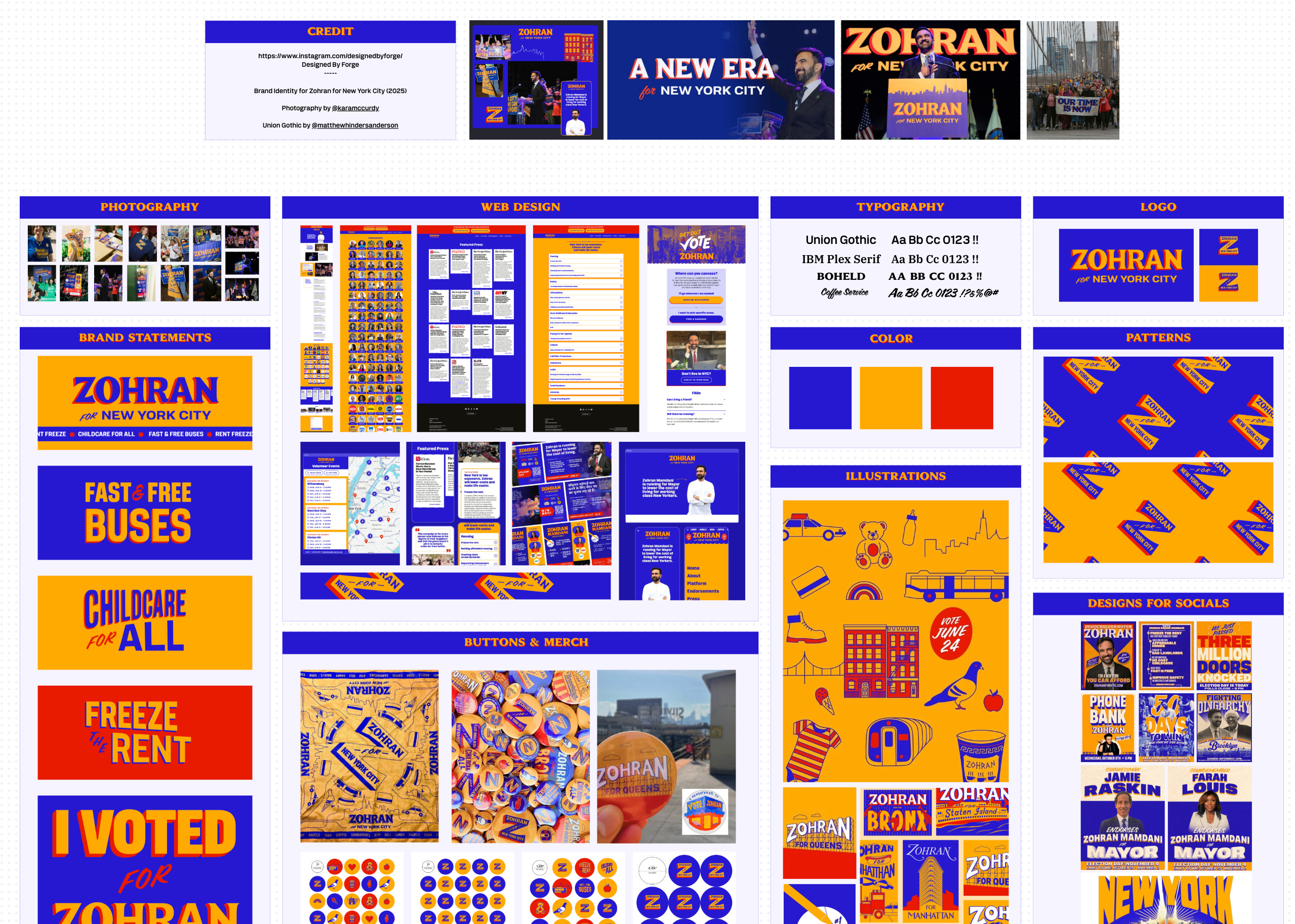
It wasn’t allergic to design; it just didn’t use design to barricade itself off. The team opened the floodgates and let supporters see themselves as fans, creating their own riffs and remixes. The brand didn’t panic. It didn’t feel threatened by amateur Canva jobs. It had a center of gravity, and people naturally orbited around it.
Compare that to Cuomo’s AI-generated material, which had the strange quality of looking both polished and lifeless at the same time, like a stock-photo-laden church brochure with the tagline, “Community matters here.” It was as if no human fingerprints were allowed anywhere near it. Call it the branding equivalent of shrink-wrap.
Shrink-wrap is what killed the Kamala campaign. The Democratic establishment tried to curate her public presence so tightly that any oxygen in the room felt like an accident. They wanted control so badly that spontaneity became a liability. When Joe Rogan didn’t leap at the chance to bring her on (how we got to that point is another story), it wasn’t because she had nothing interesting to say. Allegedly, it was because her terms were too narrow. The atmosphere around her felt sealed, the way museums seal off artifacts that can’t be exposed to light. People sense that. They wonder what happens if the curtains get pulled even an inch.
The trouble starts when authenticity stops being a byproduct of resilience and starts becoming a strategy. You can practically see those team meetings. “Can we make this appear more real?” “What if the CEO films this on a sidewalk so people know he’s the kind of guy who walks?” The whole thing becomes another layer of choreography.
If anything deserves a funeral, it’s that version of authenticity. Not the real thing, but the glossy, commercially viable imitation. Authenticity Inc.
“What do you think our approach should be?”
A few years ago, the head of a brand that had gotten huge on Instagram called me in a panic. Someone had created a parody of them, a gentle, clever send‑up of everything they were known for: the immaculate photography, the aspirational influencers, the tagline that promised “authentic community.” The parody wasn’t mean‑spirited. It was wry and playful, a lighthearted jab at just how overly polished and self‑serious the whole aesthetic had become. But it spread everywhere. For about a month it was unavoidable, showing up in the press, people’s feeds, group chats, you name it. And despite its lightness, the founder was rattled.
“What do you think our approach should be? he asked me.
I thought about it for a moment. “I’d lean into it.” I replied. “Laugh at the joke. If you respond negatively, you’ll look like you deserve to be parodied. If you have fun, you’ll prove any skepticism out there about your brand wrong.”
Ultimately, he decided to go the opposite direction than what I suggested. Their success dissipated within a few months.
Be The LEGOs You Want to See In The World
We know resilience when we encounter it:
A brand that knows itself well enough that it doesn’t disintegrate when the public starts interacting with it.
A message that doesn’t fall apart when someone asks an unscripted question.
A story that can hold its shape even when fans reinterpret it, parody it, borrow it, or even gently abuse it.
Resilience requires form. A point of view. A design language that doesn’t apologize for being designed. Think of it like Lego: intentionally shaped, thoughtfully constructed, sturdy enough to stand on its own…yet meant to be taken apart, reassembled, expanded, reimagined, and occasionally turned into something no one ever planned for. A message that invites that kind of creative interference isn’t fragile. It’s generous. It’s confident. It knows that being remixed is part of the point.
The next generation isn’t rejecting good branding. They’re rejecting fragility masked as good branding. They want the confidence that comes from a brand being genuinely itself, not because it’s trying to be relatable, but because it has nothing to hide.
So instead of announcing the death of millennial branding or authenticity branding, or any kind of branding, maybe we should announce the death of pretending that any one thing alone can carry a brand anywhere. The future belongs to the identities that can survive multiple kinds of contact—from supporters, creators, critics and disruptors alike.
Authenticity is nice. Resilience is better. And the brands that last will be the ones that let people in without losing themselves in the process.
This is such a perfect article for the moment we are in on so many levels. I wish more churches would get with this "thinking" as Authenticity would solve 75% of their problems.
Hey, great read as always. This realy hits home, reminding me of your piece on genuine impact versus mere visibility. So many 'thought leaders' out there are just performing, aren't they? 'Authenticity without architecture' is such a perfect phrase. Absolutely brilliant insight!