


“If I love you, I have to make you conscious of the things you don’t see.” — James Baldwin
It was a perfect July morning in 2021. You could see the sun peeking its way in between the skyscrapers of Hong Kong as if to say “nothing you build will ever be high enough to escape my graceful pursuit of you.” Sophie, who had moved to Hong Kong from Texas before the pandemic, met up with three of her friends at Ha Pal Lai Park. Their plan was to hike up to Pineapple Mountain, a popular spot near a beautiful waterfall. Sophie, an avid hiker who loved the outdoors since she was a kid, had recently decided she was going to try her luck at launching her own personal brand on social media. Though it had only been a few months, she had surprised herself with how successful she already was, garnering a little over 7,000 followers on Instagram. What drew them in was her risqué, provocative “selfies” often snapped at the edge of a cliff or in some other hazardous position.
Sophie and her friends made their way up to Pineapple Mountain, exchanging stories of first dates gone wrong, laughing and wiping away sun tears. Around 11am they finally reached the top of the waterfall. Sophie leaned over the very edge of the lookout, dug out her phone from her pocket, and turned around. She pointed the phone up toward a cloudless sky capturing as much of the scene as she could—the light-freckled water, the crooked rock, and her own precarious placement within it all. Her brand was Beauty and Danger, and this was the best of both worlds.
As she pressed her thumb to the screen’s capture button, she could feel her balance start to waiver. Her friends, who had been watching a few feet away didn’t know whether to stand back or charge forward. The last image they remember of Sophie alive was the panicked plea in her wide, sober eyes.
Her brand’s Instagram page touted the mantra, “Life should be fun, not dumb.” Since her death, that brand went from 10,000 to over 42,000 followers, a return on an investment worth nothing to her now.
In the 18th century BC, a similar story began circulating in Greece about a hunter named Narcissus who, upon seeing his reflection in a pool of water, became so enamored with it that it eventually killed him. Some said he was unable to break away from the pool and therefore starved to death. Others claimed he fell into the water and drowned trying to embrace the image. Thousands of years later, most of us believe this myth to be a warning against self-obsession and vanity. The late philosopher and media critic, Marshall McLuhan, believed that many are missing the story’s moral.
“…the wisdom of the Narcissus myth does not convey any idea that Narcissus fell in love with anything he regarded as himself. Obviously he would have had very different feelings about the image had he known it was an extension or repetition of himself. It is, perhaps, indicative of the bias of our intensely technological and, therefore, narcotic culture that we have long interpreted the Narcissus story to mean that he fell in love with himself.”
McLuhan suggests that Narcissus was unaware that what he was seeing was simply a visual extension of himself, a primitive metaverse, the stuff of angles and sunlight and science. Upon seeing his reflection, a numbness kicked in, a severing of some part of his central nervous system that resulted in a deathly level of disassociation.
It’s a mistake we are now making in mass, this idea that the reflection is not merely an extension but in fact, reality. In the process, these multi-dimensional lumps of energy we lug around that are so inconveniently grounded to the earth exist only in service to the extension to the point where they are ultimately cut off from any kind of independent enjoyment or fulfillment. These are reflections we have become all too willing to risk our lives for.
Yes, that proclivity in our human nature seems as old as the story of Narcissus, but it’s the ongoing manufacturing, the commoditizing of that proclivity without us being aware or at least disciplined enough to temper it, that is the reason for such present sobriety.
“Neutrality” for the Swiss has always and continues to be a matter of interpretation.
There’s a trope I’ve recently stopped using; the one that goes “Hey, I’m Switzerland in this situation” whenever conveying a neutral stance on something inconsequential or other.
Contrary to popular belief, there is much debate over whether Switzerland was truly neutral during World War II. Some say their callous behavior towards the Jews and other practices gave Germany a massive leg-up.
Yes, the country’s official stance from a military standpoint may have indeed been “neutral” and it did take in roughly 22,000 Jews as refugees before 1942. Historians, however, point out that Switzerland’s treatment of these refugees was anything but humane. For example, Swiss banks made it extremely difficult for survivors to recover money they deposited before the War’s outbreak in 1939. After 1942, Switzerland turned away more Jews than it let in, leaving over 30,000 to perish in the Holocaust.
Recent declassified documents indicate Switzerland provided arms to Germany, a decision some modern Swiss officials justify by reminding historians that it also provided weapons to the allies as well, thus maintaining neutrality.
Greg Rickman, a senior aid for former senator Al D’Amato, who helped release some of these declassified documents, thinks otherwise. “The war would have been very difficult for (the Nazis) to have conducted and paid for without the role of Swiss banks. [Germany] needed a place to get rid of and launder things like gold and securities and bonds, and to sell the stolen and looted artwork and jewels—and it went through Switzerland.”
The reality is that “neutrality” for the Swiss has always and continues to be a matter of interpretation. In the decades since World War II, Switzerland has had to pressure test their ethos against an increasingly complex set of global questions surrounding its relationship to NATO, The United Nations, and most recently, the war between Russia and Ukraine. One might even argue that Switzerland benefits financially from this overly simplified notion of “neutrality.” Why sell weapons to one side when you can sell to both?
To claim Switzerland is neutral is to be unaware of a whole host of underlining complexities, the biggest of which is that countries are people—their ideas, decisions, preferences, and consequences. They are not simply topographical lines divorced from the culture that drew them.
“There’s nothing neutral about any technology.” — Marshall McLuhan, Forbes Magazine, 1967
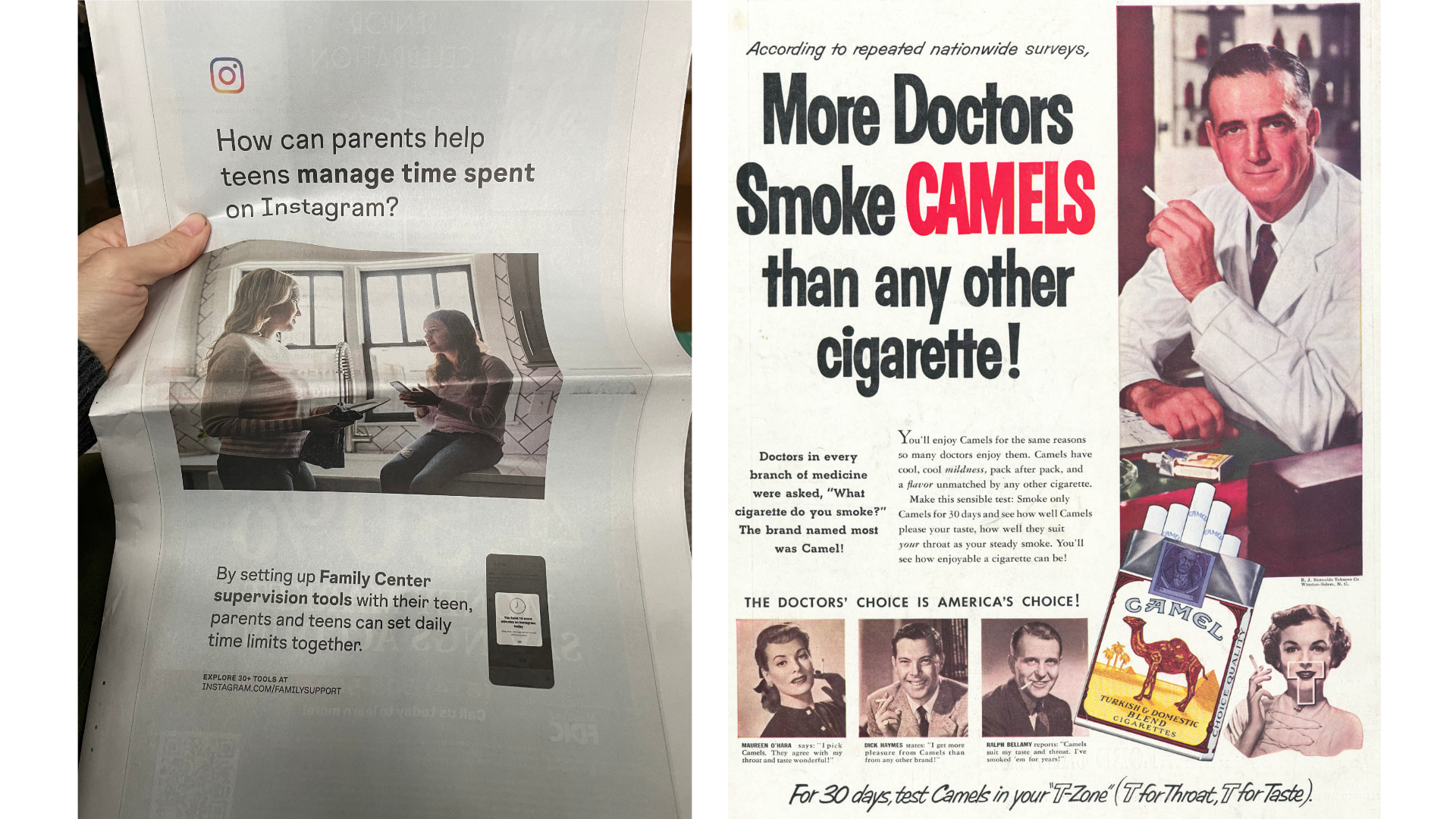
There’s another trope I think deserves the same amount of scrutiny. The motto, “Technology is not to blame in and of itself, it is simply what one does with it.” has become a quick and easy way to mitigate the communications crisis we’ve been accelerating toward for decades now. I’ve heard that rhyme repeated the most from progressive friends, those who are well-educated. Whenever they pull out this fortune cookie “is-what-it-is” mentality in conversation, the scope they are usually addressing is limited to the realm of such creature comforts as phones, tablets, and software-as-a-service. However, these same people would laugh at the equally antiquated misnomer, “guns don’t kill people, people kill people” as if a gun weren’t a piece of technology.
To be clear, I don’t think media is inherently evil. I just believe its purest application is as a launching pad for face-to-face conversations, a substitute not a shortcut. I’m also not a luddite, but I do not believe we can go around telling ourselves and our children that technology is neutral as long as we can trace its creation back to human hands for an intended purpose. That purpose used to be replacement—discarding something costly and less efficient with something cheaper and more efficient. This decision comes with a myriad of holes to poke concerning what society really values and what costs actually increase in the process be they cultural or environmental. Where my concern lies is in technology’s shift in its purpose from “replacing” to intentionally “weaponizing,” creating algorithms that reward divisive, destructive behavior for monetary value.
To consumers like us, all this weaponization lurks under the guise of community, but like any cult leader understands, that’s the brilliance of a good grift. All media throughout history replaces a sense of community and increases individualism somehow. Radio and television shrunk larger gatherings in theatres and relegated people to their homes. The Internet promised to connect the entire globe and in doing so placed a tiny screen in everyone’s hand which we use to ignore those in proximity in favor of mere reflections.
Then there’s the whole disembodiment thing.
The other night I met a guy who I’ll call Nate. He’s married, in his 30s, couple of kids, living in a subdivision outside Columbus, OH. Nate mentioned to me that over the past few years, he has gotten to know their neighbors, an older couple in their 80s. The husband was the president of their HOA and extremely thoughtful and generous. One night while over their house for dinner, Nate mentioned how much he enjoyed the bottle of wine the older couple set out. The week after, the HOA president showed up at his doorstep with a brand new bottle of the same wine. Every time both families would see each other, they would hug and greet each other warmly. A real neighborly friendship was blooming.
Or so it seemed.
Occasionally, my new friend would post something related to a current event on Facebook. Each time he did, the wife of the HOA president would comment with vitriol and venom unlike anything Nate had ever experienced from her in-person. She would attack anyone with a differing viewpoint who would chime in on his post including some of Nate’s family members and would follow up by private messaging him and them, all with an unmistakable tone of condescending disrespect.
The next day, Nate would see her jogging on the sidewalk. She’d come over to him, give him a big hug, ask him how his kids were doing, and remark how they should all get together again soon. This would happen repeatedly, leaving Nate staring blankly like a deer in the headlights wondering how to navigate this new relationship. Was he the product of gaslighting, schizophrenia, denial, or just a complete lack of self-awareness?
There are lots of reasons we can guess why this fracture was so stark. I don’t think Facebook, a platform first designed for college students, has done a particularly good job at onboarding digital immigrants and older Baby Boomers. Painting a broad brush, I’m not sure that generation was ever prepared to handle these kinds of self-extensions. In fact, you could probably write an entire book about the impact the rapid shift in media technology had on that generation alone, a generation taught that traditional morals and a steady 401K would lead to happiness and respect, that inequality was something they no longer had to assume personal responsibility for, and most importantly, that they shouldn’t express their feelings, anywhere to anyone…that to do so would be a sign of weaknesses. The anger, the disappointment, the denial had to come out somewhere.
We do not have to choose between erasing something or ignoring it, we can also decide to tell the truth about it, to wade into that holy discomfort, sift through the shame long enough to see where we went wrong.
That proclivity to disassociate, to misunderstand the Narcissus dilemma, to disembody and disconnect our real-life selves from our meta-avatars is not limited to one generation. We see it growing and growing in the habits of young people and the way technology is trending toward an entire meta-verse. It’s a pattern that’s become officially alarming.
You don’t have to be told that though. The ramifications of our algorithm-inspired life have become apparent at this point. Many of us are just not sure what can be done. Retreating from media’s reign over our daily habits would be like asking a fish to leave the ocean.
It’s an overwhelming thought which speaks to just how much power it holds over our lives.
Most of us by now have heard and experienced its addictive nature and consequences. What I refuse to accept is the response that our relationship to media cannot be harnessed or controlled, that its influence is somehow out of our power, that it cannot be reidentified, recategorized, and put it in its proper place. I am not saying we ban Switzerland from our consciousness, I’m saying we reconcile its narrative so that it mirrors reality. This can be said of any uncomfortable truth be it slavery or imperialism. We do not have to choose between erasing something or ignoring it, we can also decide to tell the truth about it, to wade into that holy discomfort, sift through the shame long enough to see where we went wrong.
Media Technology, the method by which we transmit and exchange information with each other, has become one of the 3 existential crises facing our humanity, the other 2 being Climate and Fundamentalism. Media Tech is perhaps the most under-acknowledged, an irony due to its function as a playground where both the other crises can fester and breed unrestrained.
Right now, a new wave of imperialism is far underway, what artist Jenny Odell has called “a colonizing of the self” by those who control media technology without much consequential pushback. Media Technology, the method by which we transmit and exchange information with each other, has become one of the three existential crises facing our humanity, the other two being Climate and Fundamentalism. Media Tech is perhaps the most under-acknowledged, an irony due to its function as a playground where both the other crises can fester and breed unrestrained.We can no longer afford for this to be a conversation cloaked in neutrality. Instead, we need to conjure an unprecedented sense of urgency.
Our relationship with media technology has hit an apex where it is both completely fractured and all-consuming. We minimize such dissonance at our own risk. We fall from the edges of magnificent boundaries we no longer have reverence for. Our lack of reverence and intentionality for our digital climate is just as great a threat to our species as our lack of regard for our physical one. And just like climate change, there is hope yet. There are reverse courses we can take. There are solutions worthy of our collective time and effort. But they are not evergreen. Time is running out.