


In the fall of 2021, after nearly two years spent assessing our priorities and values—thrown into the naked light after the coronavirus forced us all deep into our own “roof and walls and fireplace”—my family and I decided to sell our home in Nashville and move to Columbus, Ohio. We did so for several reasons, a few of which I’ll explain here in a bit…but first, a history lesson.
We Wound Up in “Temperance Town.”
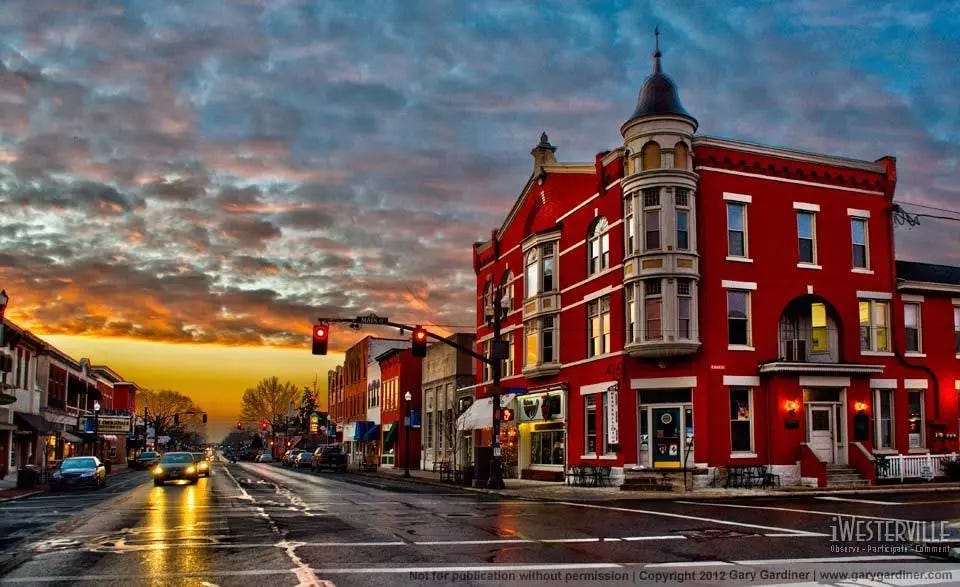
We landed in a neighborhood called Westerville, where it turned out my wife’s ancestors, a family called the Hanbys, have ties. William Hanby founded Otterbein University, just about a mile away from us, and offered his family’s modest house as a stop on the Underground Railroad. His son, a musician named Benjamin, wrote the antislavery ballad “My Darling Nelly Gray” as well as the Christmas tune “Up on the Housetop.” Westerville is an old historic college town. What we didn’t know is that more than a century ago, it became ground zero for America’s famous fight against the “demon rum.”
Indeed, Westerville was the home of the Anti-Saloon League, whose headquarters were what is now its Public Library, originally built around the league’s 1893 debut. Their emphatic war against alcohol ultimately ended in temporary victory with the national enactment of Prohibition in 1920.
Initially headquartered in Washington, DC, the League switched its operations to Westerville in 1909 for a number of reasons, the biggest of which being media and technology. Here, the league could establish and run a proper printing center. Not only was Westerville close to Columbus, it also offered a railroad station advantageous for shipping and distributing print materials all over the country. These and the fact that business owners had donated land as an incentive made the migration from DC to Westerville most opportune.
The final reason the League ultimately chose Westerville is because the town had been dry since 1859. One member of the League bragged that the city was “so dry that you have to sprinkle the streets after a rain.”
There was the occasional rebel. A man named Henry Corbin tried to open a saloon twice, in 1875 and then 1879. Both times the townspeople blew up his establishment using homemade bombs, one of which knocked two of Henry’s teeth out. He tried opening for a third time, this time carrying a pistol in each hand to defend himself. He was bombed again and switched to selling vegetables.
Unsurprisingly, the Anti-Saloon League found a supportive atmosphere in Westerville. A blurb from Ohio’s Beacon Journal expands:
Here it could tread the moral high ground, researching the physical and emotional effects of drinking, keeping tabs on liquor laws around the country and cranking out posters, paycheck inserts, children’s stories and other materials aimed at turning America against alcohol—40 tons’ worth of printed material a month in its peak years.
“Do you know? One insane person in every four owes his insanity to drink,” trumpets one of the league’s fliers on display in the museum.
Another depicts a child alone in a squalid home on Christmas Eve while Dad tosses back drinks in a bar.
There are buttons declaring “Bread Not Booze,” posters decrying the evils of liquor and copies of the American Issue, the league’s anti-alcohol newspaper. The league also published a number of books, including an annual yearbook on the progress of the liquor issue and the Standard Encyclopedia of the Alcohol Problem, an ambitious compendium of alcohol and liquor-law information collected by editor Ernest Cherrington.
Sounding over the top to our twenty-first-century sensibilities, today these anti-alcohol messages might deserve a soundtrack written by Sarah McLachlan. However, the problems the league was addressing were objectively serious. The growing nation had a shortage of clean water, directly increasing the use (and abuse) of alcohol, all amid a society where women had little autonomy, facing abuse and destitution if their husbands decided to drink away their paychecks (which many did) —a main reason why the Temperance Movement and the women’s suffrage movement were so interconnected.
That era’s cultural relationship with alcohol, something not entirely bad but very much lacking boundaries, became a growing problem that happened to carry with it several interconnected causes, all of which had a marked effect on the entire family unit, leading to several needed shifts in our democratic policy and cultural worldview. Does that remind you of any other time?
As public opinion turned against Prohibition, the league likewise fell in esteem. After Repeal in 1933, the Anti-Saloon League began a terminal decline. Westerville, however, would remain dry until 2004, when a pub called the Old Bag of Nails threw the dice and applied for a liquor license, hoping people’s reactions had tempered since the 1800s and no teeth would be lost in the process:
As it turned out, voters by an overwhelming margin—71 percent—approved the license for the Old Bag of Nails pub. Before the pub could be renovated and opened, though, Michael’s Pizza got a liquor license, too. It was there, on Jan. 12, 2006, that the first beer since 1933 (a Budweiser) was served Uptown.
The shift awakened the laden potential of this small, historic blip of a college town. Tony Cabilovsk, the owner of one of my favorite local watering holes, affectionately named Temperance Brewing, recalls a different kind of Westerville than the one he knows today. “Ten years ago, if you went through Westerville at 8 pm on a Tuesday, it was a ghost town. Now it’s vibrant, and it’s not just the restaurants and bars that are full, it’s the boutiques and shops, as well.”
By the way, not long after Tony opened in 2015, a decedent of Henry Corbin stopped in to say thanks for succeeding where his ancestor had tried in vain. If you ever visit, look me up and we’ll get a couple of beers from Temperance named in Henry’s honor: “Corbin’s Revenge” and “Two Pistols.”
Outside of Westerville City Hall, there’s now a sculpture of a broken whiskey barrel. The town plumbed it with water so it looks like it’s spilling out the sides, an homage to what Westerville once fought for, and a celebration of what it no longer needed to.
This All Feels Familiar.
I go back and forth on which side of Prohibition I would have found myself. Given some of the reasoning behind the desire to deny alcohol to the public, it’s also easy to conjure empathy for those fighting for a ban on something that had gotten out of control. Alcohol wasn’t the reason women were disempowered or children left vulnerable, but its toxicity, when used without discretion or foresight, worsened many of the inequitable problems already facing the culture. Again, stop me when you’ve heard this one.
But in a much larger way, the whole thing sounds archaic, myopic, and hypermoralistic. The evidence that the amendment caused more harm than good is overwhelming. Prohibition was ultimately ineffective when strictly enforced from the top down. Yes, there were bad actors and ignorant practices when it came to producing and selling alcohol, but there were also immigrants who, over thousands of years in the regions that became Germany, had perfected the slow process of crafting excellent, low-ABV beer. Prohibition blacklisted them both. In the end, the need to climb from the depths of the Great Depression made Prohibition too costly a battle, and its legacy a failure to accomplish what it set out to do.
Intimate Networks > Pseudo-Solutions.
Around 1935, two years after Prohibition’s repeal, another movement began percolating just about ninety minutes north of Westerville in Akron, Ohio. A man named Bill Wilson, who had been struggling with alcoholism his entire life and had been in and out of rehabilitation programs, had just come to Ohio for a business trip. The deal ended up falling through and the entire journey was looking like yet another personal failure, one more piled atop a crushing heap of them. Tempted to run to the nearest local bar, Wilson, in a moment of lucidity, came up with a Hail Mary idea. He needed to find another alcoholic. Perhaps focusing on helping someone else stay sober would steer his attention toward a solution more fulfilling than cheap whiskey.
He got his hands on a local church directory and began randomly calling numbers. I’d love to know how those conversations went.
“Are you an alcoholic?
“No?
“All right, know anyone who is? . . . Hello?”
Finally, Bill found Bob Smith. The two began meeting, sharing stories, helping each other through their darkest memories, and encouraging each other when temptation knocked at their door. It worked. A failed business trip to Akron successfully birthed Alcoholics Anonymous, a program Bill and Bob centered around small, intimate gatherings of people sharing the story of their addiction with each other, acknowledging their intention to quit, and agreeing to call each other if tempted to backslide. Nearly a century since its inception, many see AA as one of the most effective methods for treating alcoholism.
The architecture of the Alcoholics Anonymous network is fascinating. Local AA groups are products of spontaneous order, people assembling without any significant hierarchy or institution pulling the strings. Instead, there are guiding principles, or traditions, shared and valued between participants centered around this idea of ordinariness, one of them being the suggestion that members remain anonymous when speaking to public media, and that no one use the group for their own personal financial gain or celebrity.
It’s as if the intimate infrastructure Bill and Bob designed held a mirror to the Prohibition movement and replied, “This is how you change a culture, not by public shame and sweeping regulation, but one soul at a time, in the company of a few fellow ordinary humans, holding nothing more but each other in the fragile solidarity of hope.”
It’s the reason we moved.
Speaking of Addicts, Johnny Cash’s Ghost Visited Us.
Back to Temperance Town and why we decided to make our home. Apart from Westerville reorienting its attention from championing Prohibition to investing in incredible public spaces—libraries, parks, schools, and bike paths—one of the central reasons we migrated there was a longing for that sense of solidarity, a genuine feeling of community and neighborhood we had been lacking. Two more reasons were our friends John and Erin.
Of all the places in the world, I met John and Erin on an old farm Johnny Cash used to own. We were all living in Nashville at the time and had been invited by a wealthy, eccentric old man who had recently bought the sprawling property in Bon Aqua, Tennessee. We traversed the acreage, stomping through the muddy grass, avoiding cow pies and strange looks from curious locals to help the mysterious old man envision what he might do with the place now that he owned it. The conversation never really went anywhere consequential (I’m not even sure if he still owns the place), but it was one of those strange, serendipitous encounters, meeting the folks who’d become some of your best friends on a parcel where an American storytelling giant once ate, slept, worked, and played. Was the ghost of Johnny Cash still presiding over his old haunts, still making stories and stringing together unlikely harmonies? Was he upset that I had used his heated toilet seat?
John and Erin had a daughter just a few years older than ours. All of us just seemed to click: John with me; Erin with my wife, Kelly; and their daughter, Lilly, with our daughter, Selah. Rare, right? Anyone in a serious relationship with a partner will know what I mean when I say that the odds of making compatible friendships get cut in half once you decide to double up your life with someone else. Add kids to that equation and it becomes exponentially harder!
There was something else that my wife and I had in common with John and Erin. We were both trying to practice some intentionality when it came to raising our kids in the age of the Great Distraction, a similarity that turned out to be remarkably helpful. To be aligned with other parents who didn’t want the next generation to fuse so singularly with their technological devices that they forgot the beauty of their ordinary, untethered selves helped shape how both of our kids played together. There wasn’t an excessive fear of missing out because Selah had Lilly and Lilly had Selah.
I remember the day, a little over a year later from that ghostly encounter on the farm, when John told me they’d decided to move back to Columbus to be closer to aging family. My heart sank and yet I knew somehow this wasn’t the end. There was still another verse to this song. It just needed a bridge.
After they moved, we visited each other frequently in order to keep spending time together. Every time we visited them in Columbus, I felt more and more like it was a city where I could imagine us raising our kids. There’s an international and immigrant influence that reminded me of growing up in New York, the kind that produces a diversity in everything—food, music, culture, politics.
I had missed that in the insulated little suburb where we’d settled outside of Nashville. Sure, it was beautiful, but everything was homogeneous, which made me wonder if I was confusing actual beauty with a script about such things. Maybe I had kayfabed myself.
I wanted my kids to grow up normalizing diversity and a more sophisticated understanding of our storied, multifaceted history, full of collaborative triumph and collective failures. Especially once the 2020s rolled around, it seemed like many Southerners were doubling down on some old narratives, ensuring we kept teaching our kids “alternative facts.”
Most importantly, I wanted to live among a fellowship of friends with similar values when it came to the parents we wanted to be, the kinds of kids we wanted to raise, and the communities we wanted to shape. We moved to Westerville, Ohio, of all places, to find ourselves among a small circle of companions who were rejecting the lure of personal branding and media addiction for a life centered around each other, the prevailing gifts of ordinary work and play, of the simple principles and traditions our families would thrive under, especially our kids.
It's one thing to attempt those traditions or try to mandate them. It’s another thing to practice them in community alongside others. This is what Bill and Bob understood that the Temperance Movement didn’t.
The other morning, I walked to the local Westerville doughnut shop when I overheard a mom pleading with her ten- or eleven-year-old boy to put down his phone and join the moment. You and I have heard this exchange thousands of times. We’ve even identified with this poor mom just trying to do the right thing. This resulted in the typical eye rolls and power struggle as it framed the conversation around what the boy would rather do versus what he “ought to do” (even if that wasn’t his mom’s intent).
Turning down the noise doesn’t imply simply trusting your ten-year-old with a privacy-sucking machine and occasionally monitoring screen time when you feel it’s appropriate. That’s a strategy we can all agree isn’t working. There needs to be another step, a greater intentionality worth exploring, one that’s more concerned with seeking out community than making compromises.
Instead of Scrolling, We Can Practice Neighborhood.
Once we found our people, it became easier to create a family rhythm that allowed for the use of media technology without succumbing to the Great Distraction.
To be clear, I am not advocating we all go about creating enclaves of Luddite children with no sense of media literacy. Our little Columbus kid collective watches movies and TV shows together on occasion. They also ride their bikes, play hide and seek, and make lemonade stands.
More importantly, I’m not suggesting you need to move somewhere different from where you already find yourself. My aim is to simply pose a question I had to ask myself at some point, a question every addict, be it to alcohol or media, must ask: What people will remind you of your ordinariness and love you for it? What will you do to seek them out and make sure they’re never far? What step of courage and discomfort may be necessary to find solidarity and support amid a culture that praises rugged individualism and autonomy?
Finally, I realize how remarkably lonely life can feel in our modern era of pseudo relationships gated by screens and devices. The community and belonging you long for may seem impossible to access while media technology, on the other hand, is faithful as the day is long. I’m struck by Bill Wilson’s tenacity to find Bob Smith, combing through the church directory, talking to anyone who’d pick up the phone. Without trivializing the difficulty of what I’m about to suggest, perhaps lean into the awkwardness of making your ordinary presence known. Fight to be sought out, seen, and listened to by seeking out, seeing, and listening to your fellow earthly travelers. When the impulse comes to post a political opinion online, search for the nearest volunteer opportunity. Join a club in the wake of joining a chatroom. Invest in an exercise group that meets down the street instead of purchasing a Peloton bike. Step across the rickety threshold of your own incarnation to find the very same desires you have in those who share a common sky.
None of us will live to see a prohibition of media technology and all its anxiety-producing consequences. Nor should it be prohibited. We’ve been down that road before. It would be difficult to restrict the bad without eliminating all the good this technology has produced. What we can do is find each other, rekindle the abandoned sacrament of neighborhood, and see us as the common siblings we once were, before the Great Distraction.
Worth noting, these relationships do not have to align completely with each other or always agree on best practices. When it comes to our little Columbus community, we’re all simply doing the research, making the best educated guesses we can, and trying to deliver what we think our kids uniquely need from us. I’ve come to enjoy dialoguing with John and mutual friends about what works for their kids versus mine, what is turning out to be helpful versus what’s backfiring, how their thoughts and opinions are changing as their kids grow older, and how to navigate the fact that my wife and I may land at different conclusions at different points for our own.
If that sounds like a lot of work, it can be. Occasional discomfort is the currency that subsidizes genuine community. Try as some may, you cannot automate away the human desire for human relationship. To make matters a bit more complicated, you and I know quite well that our capacity for that particular flavor of nuanced long-form communication has been challenged, conditioned out of us by an overreliance on the very devices we are trying to limit, not to mention nearly two years spent in isolation warding off a global pandemic.
In fact, for all the societal catching up we are now having to do after March 2020 forced us into near isolation, perhaps one aspect we can retain as we come out of the depths of the pandemic is the emergence of localized “pods” or “clusters”: groups of families who agreed to limit social interactions to each other so they could at least spend time in physical proximity, enjoying the natural, grounded world around them, cooking, eating, connecting in all three dimensions, reveling in the awkward reawakening of all five senses. As horrible as the coronavirus has been for countless people around the world, for all the physical, emotional, and financial struggle it continues to cause, for me the global pandemic paradoxically also became a time of great healing, a reconnecting with what’s most important, closest, and present; a necessary inward correction, a darkening that turned what was light into a laser.
It turns out that close, compact networks are the remedy for ones that depend solely on the loose slack of somewhat-social media…They produce the kind of connectivity that is the antithesis of a pseudo-anonymous online back-and-forth or reality-blurring competition online. It’s not attention seeking but empathy sharing. The oposite of isolation is compassion.
This Essay Was Adapted from My New Book.
The Forgotten Art of Being Ordinary is out now! If you’ve started reading it, spread the word by leaving a review on Amazon. If you haven’t picked your copy up yet, grab it here!