


Some Housekeeping: This Question is My Boomerang
I was talking to a friend from New York last week. And when I say he’s from New York I mean, he’s really from New York. The guy used to run sound for Sinatra…that kind of New Yorker.
He asked me what I thought the reason for Reculture’s current season of growth was. You ever get a value proposition handed back to you better than you articulated yourself? This was one of those moments.
“I get it,” he said casually in his thick pre-hipster-Brooklyn accent. “You can get people’s attention but then you gotta know where to go with it.”
Depending on how long you’ve been following my work, you’ll know, like many of our vocations, it’s evolved over the years. (sits back and basks in the cleanness of that sentence thinking, “they’ll never suspect that it’s felt more like a non-linear roller coaster with the seatbelt flown off halfway through”).
However, the thing I attribute most to this growth period for Reculture is that, while yes, some of my work over the past 15 years might seem different on the surface, it’s really all been orbiting this one question: why do some stories stick with us while others disappear the second our attention moves on?
I think people are exhausted by how empty so much modern communication feels right now…which is why I keep coming back to ideas like artifacts, adventure, myths, voice…the kinds of things people actually lean into when so much is incentivizing them to lean back.
And lately, it seems like these ideas are often the exact same ideas leadership teams are wanting to unpack in person (i.e., certain podcast episodes have now become signature keynotes, workshops, and premises for advisory work). And I think it’s because the central tension is something we can no longer avoid at this juncture in history:
Attention has gotten easy. Meaning is becoming harder.
And I think the organizations that survive the next decade will probably understand the difference most acutely.
Your Audience is Split
This past weekend several commencement speeches were made at universities where two things happened:
The speaker praised AI.
The crowd of graduates booed.
I have to admit, it gave me a bit of a dopamine hit to watch the expression of multiple “distinguished” speakers go from extreme confidence to “whoops, I have no idea how to get this train back on track.”
The more cultural data like this I collect, the more I see a communication problem every brand is about to inherit: Two polarizing bubbles hardening, calcifying, and cementing themselves.
“What? There’s yet ANOTHER place we’re all polarized, CJ??”
Yes. It brings me no joy to say so. But it seems that more than a decade of flattening nuance in favor of a quick dope hit (see above) is starting to finally have some effect on the human population (Shocking!).
Camp 1: The Maxxers
Undeniably, we’re living in this exciting unprecedented age where you can now “optimize” just about anything. It used to be people could make excuses for not getting therapy, not knowing how to cook, not getting in shape. “I don’t have the income.” “Pinterest recipes leave out major details.” “I can’t find the right personal trainer.”
But now, for anywhere from $0-$20 a month, you can maxx any skill you want with a friendly expert at your side. It’s no coincidence we’ve seen a rise in lookmaxxing, moneymaxxing, and even Catholicmaxxing.
These are people who see this moment as an opportunity to optimize the optimization…optimally. Energy deficient data centers, workforce disruption, and questions about copyright are simply loss leaders for the net positive of finally being able to achieve the best versions of our lives.
Camp 2: The Enoughs
Then there’s the camp that hears the phrase “AI” and runs, judges, laughs, or…perhaps most relevant…boos.
Not only are millennial grownups having to contend with the existential crisis of being replaced while oil prices rise, their kids are graduating from high school and college wondering what the past four years were for.
They’re concerned about the environmental impact, the emphasis on replacing human creative skills, and the moral disconnect. Anthropic can hire a creator to make an ad on 35mm film in the hopes of signaling, “Hey we’re human and artsy!” But to Enoughs, the mismatch between aesthetic and action is worse than if they didn’t try at all.
The through-line I keep seeing in this camp: Enoughs repeatedly reject the assumption from those in power that just because something is new, shiny, or novel, “the kiddos will love it!” That’s the assumption those commencement speakers made, realizing, in real-time, they may have bet on the wrong horse.
"So what’s the right horse? Perhaps a clue…
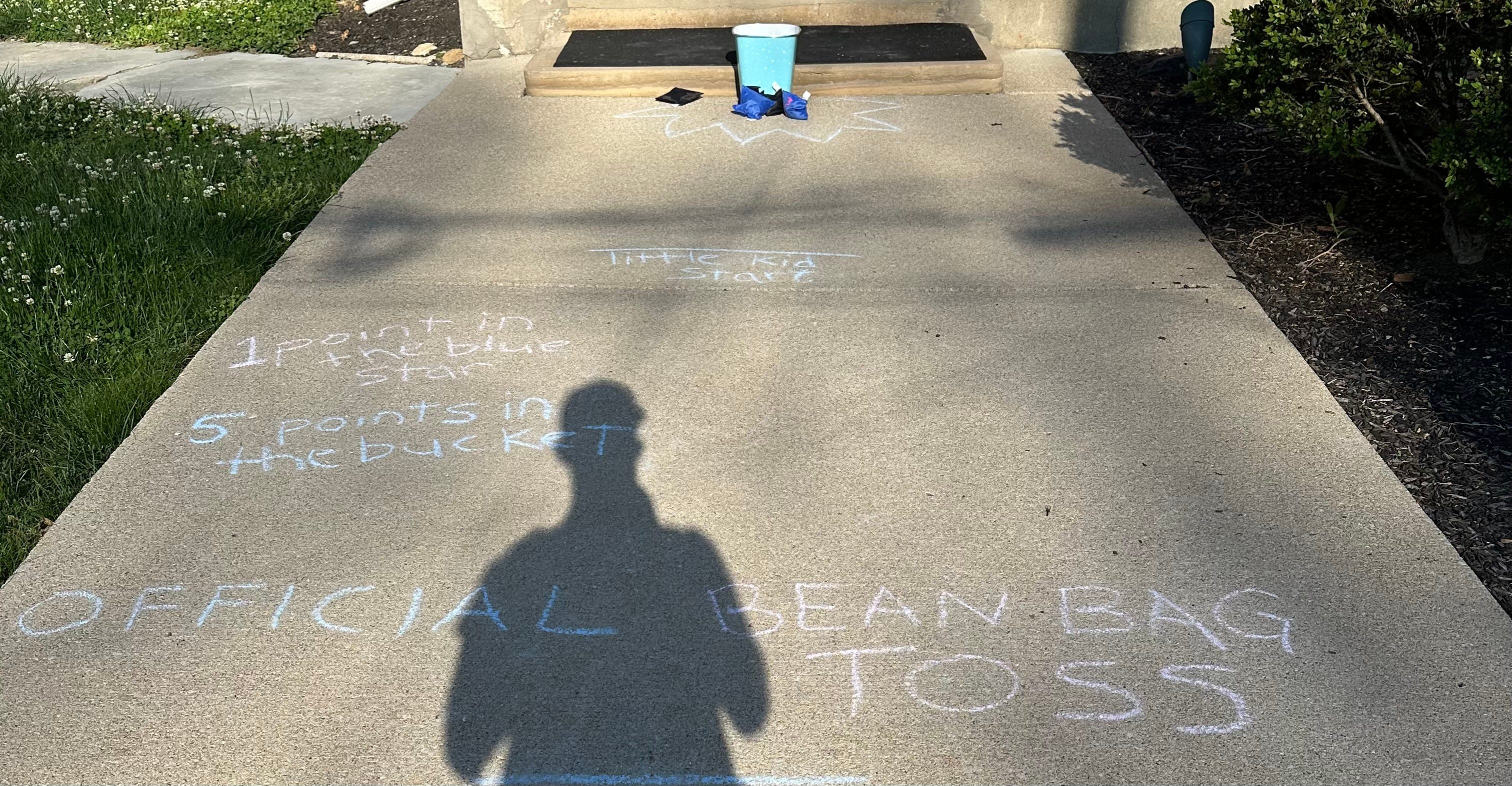
I took this picture of a game some kids made over the weekend on my walk through our neighborhood this morning. No one asked them to create this challenge. They wanted to. More than that, they were ready to hand a prize out to whoever could complete the challenge. Fascinating how our human minds work even at an early age.
The one thing I see that unites these two polarized camps? “Effort.”
Regardless of where we fall on the spectrum, humans seem to choose the brands, stories, and experiences that cost something to make. It seems like, even with all these new tools, we can’t escape the fact that if we want people to pay attention we have to earn it from them somehow.
What does this mean practically? Well, for one, I think everyone gets a free pass for the past year. We’ve been collectively experimenting with AI, figuring out what’s worth adopting and what’s not, all while the plane is being built in mid-air. Together, we’ve experienced all the feelings from exhilaration and exhaustion to encouragement and embarrassment.
That said, given these camps, the age of experimenting and novelty is now over. Everyone can tell Chat GPT’s voice ticks now (and Claude’s, and Gemini’s, and Co-pilot’s). I’s time to decide, “Am I speaking mainly to optimizers or people allergic to these shortcuts?” Either way, pretending like no one can see them for what they are…shortcuts… is a losing battle.
We’ll talk much more about this on next week’s podcast, but even if these models become better at things like writing and visual art, what makes humans latch on to a specific type of voice or visual isn’t necessarily the fact that it’s perfect, but the feeling that it cost something to make.
At some point, whether we’re maxxing or resisting, optimizing or opting out, we’re going to have to show our work.